


- Pediatric Epilepsy & Febrile Seizures Clinic
- Cerebral Palsy Clinic
- Pediatric Headache & Migraine Clinic
- Pediatric Movement Disorders Clinic
- Genetic & Neurometabolic Neurology Clinic
- Pediatric Nerve & Muscle Disorders Clinic
- Developmental Delay & Early Intervention Clinic
- Autism, ADHD, Learning Difficulties & Behavioural Neurology Clinic
- Pediatric Neurodiagnostic Lab (EEG, NCS, EMG, Evoked Potentials/BERA)
Parkinson’s Disease &
Movement Disorders

Parkinson’s disease and other movement disorders affect how smoothly and automatically the body moves. Patients may notice shaking (tremor), stiffness, slowness of movement, imbalance, or abnormal involuntary movements. Over time, these can interfere with walking, writing, speech, day-to-day tasks and overall independence. At Vishwalata NeuroConnect, Navi Mumbai, our goal is to provide early diagnosis, scientific treatment, and long-term support so that patients and families can maintain maximum function and quality of life.
Early and accurate diagnosis matters because
- Some movement disorders are highly treatable with the right medication adjustments.
- Many symptoms can be improved with physiotherapy, gait and balance training, and speech therapy.
- Timely treatment helps prevent falls, fractures, and loss of independence.
- Certain atypical or secondary parkinsonism (drug-induced, vascular, metabolic) can improve significantly if the cause is identified early.
Understanding Parkinson’s & Movement Disorders
Parkinson’s disease is a chronic, progressive neurological condition in which certain brain cells that produce dopamine (a chemical needed for smooth movement) gradually degenerate. This leads to slowness (bradykinesia), stiffness (rigidity), resting tremor, and postural instability. Many patients also experience soft speech, small handwriting, sleep disturbances, constipation, mood changes, and memory issues as the disease advances.
“Movement disorders” is a broader term that includes conditions with too little movement (like Parkinson’s, atypical parkinsonism, dystonia) and too much movement (like chorea, tics, myoclonus, tremors). Not all tremors are Parkinson’s – for example, essential tremor is a common condition causing action tremor of hands or head, often familial, and managed differently from Parkinson’s.
Clinical Insights (Etiology, Phases & Management)
From a clinical standpoint, Parkinson’s disease is characterized by degeneration of dopaminergic neurons in the substantia nigra and presence of Lewy bodies, leading to motor and non-motor symptoms. Diagnosis is primarily clinical, based on cardinal features (bradykinesia plus tremor or rigidity) and response to dopaminergic therapy. Important differentials include drug-induced parkinsonism (antipsychotics, certain antiemetics), vascular parkinsonism, and atypical parkinsonian syndromes (MSA, PSP, CBD).
Management is multi-step and individualized:
Medication
First-line in most patients is Levodopa (with Carbidopa) or dopamine agonists, titrated according to age, comorbidities, and symptom severity. Adjuncts like MAO-B inhibitors, COMT inhibitors, or amantadine may be added over time to improve symptom control or manage fluctuations/dyskinesia.
Acute / episodic issues
Sudden worsening of mobility (“off” periods), freezing of gait, or acute confusion may be triggered by infection, missed doses, or drug interactions. Management involves correcting the trigger, optimizing dopaminergic medication, and ruling out acute neurological events (like stroke).
Non-motor symptom management
Depression, anxiety, sleep disturbances, orthostatic hypotension, constipation, urinary issues, and cognitive decline often need parallel management with tailored pharmacological and non-pharmacological strategies.
Advanced stages / device-based therapy
In selected patients with significant “on-off” fluctuations or troublesome dyskinesias despite optimized medication, Deep Brain Stimulation (DBS) or infusion therapies may be considered at specialized centers.
Rehabilitation
Physiotherapy, gait and balance training, occupational therapy, and speech/swallow therapy are critical at all stages to maintain function, prevent falls, and support communication and nutrition.
Movement disorders beyond Parkinson’s (essential tremor, dystonia, chorea, tics, myoclonus) are evaluated with detailed history, examination, and targeted investigations (imaging, metabolic, autoimmune/genetic work-up when indicated). Treatment may include specific medications (e.g., propranolol/primidone for essential tremor, anticholinergics or botulinum toxin for dystonia, VMAT2 inhibitors for chorea), and in severe cases, DBS or other interventional options.
Conditions We Treat
At the Parkinson’s & Movement Disorders Clinic – Vishwalata NeuroConnect, we assess and manage:
Parkinson’s disease (early and advanced)
Young-onset Parkinson’s disease
Parkinson-plus / atypical parkinsonism (PSP, MSA, CBD, etc.)
Chorea and ballism (including hereditary causes)
Vascular parkinsonism
Essential tremor and other tremor disorders
Dystonia (focal dystonia such as cervical dystonia, writer’s cramp, blepharospasm)
Drug-induced parkinsonism (e.g., due to antipsychotics, certain antiemetics)
Tics and Tourette syndrome
Myoclonus and other hyperkinetic movement disorders
Gait and balance disorders due to neurological causes (including post-stroke, neuropathy-related, and cerebellar ataxias)

Red Flags - When to Consult a Neurologist
You should seek neurology consultation if you or a loved one notice:
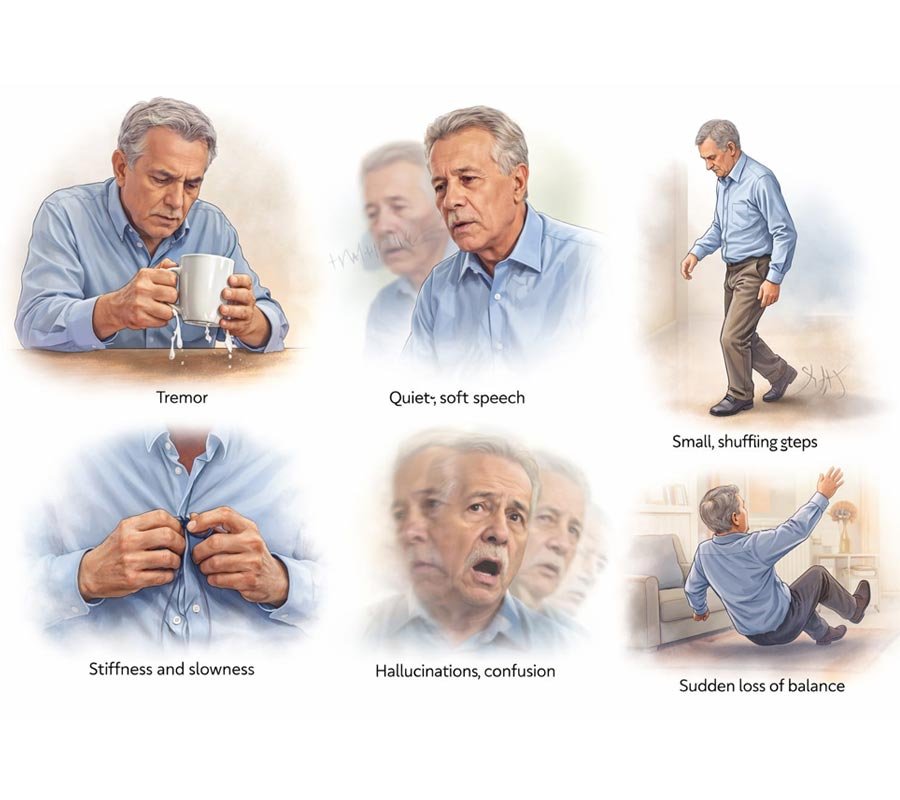
- New tremor in rest or while using the hands (e.g., cup shaking, difficulty writing)
- Slowness and stiffness interfering with walking, buttoning clothes, shaving, or daily work
- Change in walking pattern - reduced arm swing, small shuffling steps, frequent imbalance or near-falls
- Soft, low-volume speech, reduced facial expressions, or smaller handwriting (micrographia)
- Uncontrolled movements – twisting neck, clenching of the jaw or eyes, jerky movements of limbs or face, repeated tics
- Frequent falls, freezing episodes, or sudden worsening of mobility in someone already diagnosed with Parkinson’s
- Hallucinations, confusion, or significant mood changes after starting or changing Parkinson’s medications
- For sudden onset weakness, acute imbalance, slurred speech, or altered sensorium, always treat it as an emergency and rule out stroke first.
Why Choose Vishwalata NeuroConnect for Parkinson’s & Movement Disorders?


Take the First Step Today
If you or your family member is experiencing tremors, slowness, stiffness, imbalance, or any unusual movements, early evaluation can make a significant difference in long-term outcome.
Book an appointment with the Parkinson’s & Movement Disorders Clinic at Vishwalata NeuroConnect to:
- Get a clear diagnosis and explanation of your condition
- Start an individualized treatment and rehabilitation plan
- Review current medications and optimize them safely
- Receive guidance on exercise, fall prevention, and long-term planning
Call us / WhatsApp us / Book online for a consultation with our Parkinson’s specialist in Navi Mumbai (Vashi | Koparkhairane) and take a confident step towards better movement and independence.